
SEWAGE
Sewage (or domestic wastewater or municipal wastewater) is a type of wastewater that is produced from a community of people. It is characterized by volume or rate of flow, physical condition, chemical and toxic constituents, and its bacteriologic
status (which organisms it contains and in what quantities). It consists mostly of greywater (from sinks, tubs, showers, dishwashers, and clothes washers), blackwater (the water used to flush toilets, combined with the human waste that it flushes
away); soaps and detergents; and toilet paper (less so in regions where bidets are widely used instead of paper). This generated Sewage find its way into environment and the nature is scientifically so equipped that it breakdown its constituents and are assimilated. But since last century population and urbanisation increased manifold as a result sewage generation also which limits capacity to absorb it environmentally.
Hence, to save the environment which is abided by law also, requires treatment before disposal so that it does not pollute environment With strong R&D and a passion for innovation, TGES has honed its skills in handling these problems across any sector.
REQUIREMENT OF SEWAGE TREATMENT PLANT
- Hotels,Malls, Restaurants,Resorts.
- Collonies , Apartments, Societies.
- Smart Villages, Smart Cities.
- Minicipalities, Nagar Panchayat, Nagar Nigam.
- All type of Industry where water is used for daily activity.
Bus stand, Railways. - Large temples.
All kind of large community gathering places.
SEWAGE TREATMENT
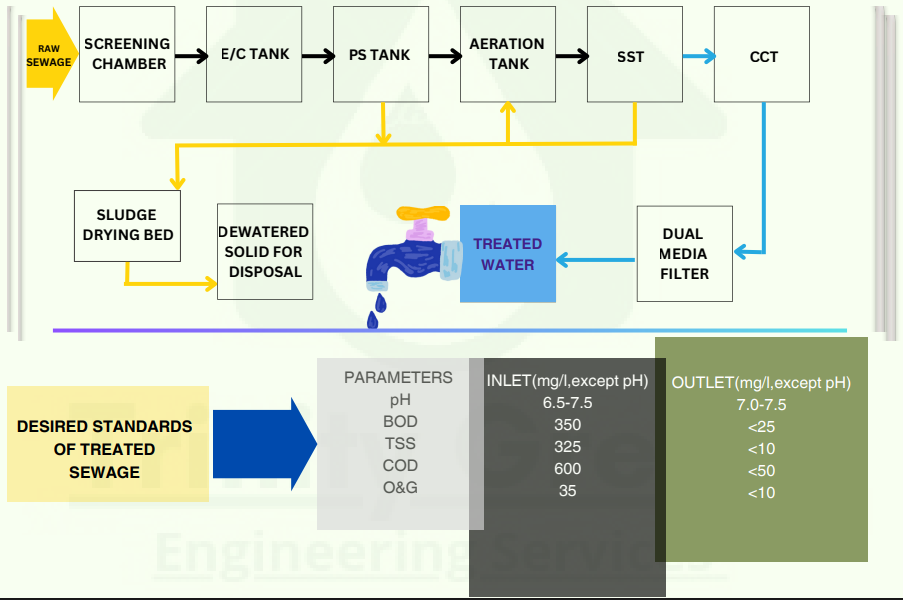
Sewage Treatment plants utilize a number of unit operations and processes to achieve the desired degree of
treatment. The collective treatment schematic is called a flow scheme, process diagram, flow sheet, process trains,
or flow schematic. Many different process trains can be developed from various unit operations and processes for
the desired degree of treatment.